

“Agents for hour-long tasks will dominate AI + Crypto in 2026. Towards our mission of a radically fair economy, Harmony is focusing on DeFi strategies, transformative applications, and community incentives.”
-Stephen Tse
“By bridging the gap between backtested theory and live execution, we are refining strategies that combine liquidity provision with hedging to navigate volatility and solve the core challenges of DeFi.”
-Li Jiang
This principle shaped Harmony’s progress throughout 2025 and came into sharp focus in Q4. The team moved from setting up data measurement infrastructure and backtesting models to integrated systems operating in live execution platforms including decentralized exchanges (Aerodrome), perpetuals (Hyperliquid), and options (Deribit, Derive).
“In December and Q4, we verified virtual position fee accuracy, tested and simulated a dynamic hedge strategy with real data, and formulated a new, more robust option hedging mechanism. These closed the gaps we had for the systems we built in 2025: autonomous trading bot with hedging, LP testing and simulation, and high-resolution per position and per account analytics.”
-Aaron Li
Q4 Team Progress
In Q4, Harmony completed the 1.10 mainnet release, which included EVM improvements and reliability fixes. A primary technical milestone was the preparation of Stream Sync for mainnet deployment, following revisions to peer selection, error handling, and synchronization logic. These updates align the protocol’s architecture more closely with upstream Ethereum development.
In tandem, the team updated infrastructure for operations and on-chain strategy. This initiative included developing tools for liquidity analysis, hedging, and copy-trading, alongside the integration of wallet-level analytics and refined performance metrics.
2026 Focus
In Q1 2026, work will focus on the Stream Sync mainnet rollout and stability improvements ahead of a scheduled network upgrade. The roadmap includes further EVM compatibility work and the activation of remaining protocol features. Initial testing will also begin on reduced block times to increase network throughput.
Also, hedging and copy-trading tools will move from development into validation and live integration. This transition will be supported by updated analytics, observability metrics, and infrastructure refinements.
Protocol & Platform
⛓️Konstantin Potapov
During Q4, release testing revealed that the embedded JavaScript engine (Duktape) caused node crashes under specific tracing workloads. To address this, it was replaced with the more stable Goja engine. The upgrade required updating Harmony’s internal tracers, resulting in approximately 7,000 lines of code changes along with corresponding test adjustments. I also activated transient storage (EIP-1153) and completed the rollout of the 1.10 release to mainnet.
2026 Q1 Plan:
Activate the remaining features from the 1.10 and 1.11 updates and launch the 1-second block-time configuration on testnet.
♏️Gheis Mohammadi
Q4 was one of my impactful quarters this year. I delivered major improvements across Harmony’s sync and core layers, while playing a central role in preparing the 2025.1.2 release which is finalized and ready for publication. This release is one of the largest in terms of code additions, and it marks a historic milestone: Stream Sync will be enabled on mainnet for the first time, a major step toward a more decentralized and resilient synchronization model for Harmony.
Throughout the quarter, I strengthened every layer of the sync pipeline. I refactored trusted peer logic, enhanced metrics, fixed race conditions, and made the peer-selection process smarter and more adaptive. Stream Sync proved its reliability and was officially promoted to the default mechanism across devnet and testnet.
A key highlight was implementing a full error-classification system for stream read/write operations. By distinguishing recoverable from critical errors, the network now avoids unnecessary stream drops due to transient conditions—an upgrade that translated directly into more stable deployments. I also delivered protocol-level improvements like EIP-3855 (PUSH0) and refactored EIP-2935 to stay aligned with upstream Ethereum changes.
Q1 2026 Plan:
Stream Sync Enhancements Improve resource usage, optimize performance, refine startup bootstrapping, and monitor mainnet to address any possible bugs to further stabilize and harden mainnet Stream Sync.
Next Major Harmony Release (Hardfork) Prepare and implement one of the largest hardforks in Harmony’s history, introducing significant protocol upgrades and architectural improvements.
EVM Improvements & Optimizations Continue enhancing Harmony’s EVM by implementing new Ethereum updates, optimizing performance paths, and improving compatibility wherever possible.
🤲Ulad Muraveika
During Q4, I focused heavily on reviewing and improving our infrastructure and associated costs, as I am now the primary owner of this area. This included auditing existing setups, identifying unused or outdated components, and ensuring our environments remain efficient and maintainable. In parallel, I continued supporting multiple release efforts - deploying eth 1.10 updates, trusted-node improvements, and stream-sync bundles across environments - while unblocking key work such as the Duktape→Goja migration and BEP44 support in the Harmony CLI.
A major part of my goals this quarter was enhancing our observability stack, where I delivered the new crash-logging pipeline, migrated log ingestion to journald, broadened dashboard coverage, and added visibility into trusted-node behavior. I also introduced version-monitoring automation. In parallel, I worked with the team to prepare for the stream-sync alpha release on mainnet by testing new logic, validating improvements, and documenting operational runbooks.
2026 Q1 Plan:
Help the consensus development team with Stream Sync mainnet rollout.
Complete the GitOps-based Grafana sync rollout, expand the crash-collection and observability stack with new metrics and stability checks, e.g. domain expiration checks.
Improve the situation with the monitoring stack - start to use LTS versions everywhere and upgrade them as new versions arrive.
Product & Tools
🌻 Yuriy Menkov
The primary development focus this quarter was the copy-trading bot. First build was a basic version that replicated position openings and closings, and then an advanced version capable of copying staking actions and operating through a smart contract. The smart contract enables efficient batching of multiple actions such as, opening a position, approving a token, and staking into a single transaction. We also conducted research and optimization to ensure the bot operates reliably with flash blocks and accelerated event processing, resulting in the ability to react to target-strategy events within the same block.
A large amount of statistical data was also collected from various wallets as well during the testing of the copy-trading bot. Together, the team performed an in-depth analysis and refined our understanding of the optimal wallet for copy — specifically, the parameters related to position duration and the amount of capital managed by a wallet. At this stage, we have identified a target wallet to copy, currently demonstrating a positive APR of 120%.
A statistical analysis identified a set of parameters for filtering wallets suitable for copy-trading: median position duration of 10–100 blocks, deposit size no greater than 5% of the pool’s liquidity, and an APR above 50%. Several wallets matching these criteria have now been found — we are currently using one with an annual APR of 150%. Additional tools were also added to compare wallet operations in real time.
Q1 2026 Plan:
Add hedging functionality to the copy-trading bot and integrate it with a hedging-analytics service to enable real-time long and short position generation. Expand the collection of hedging-related statistical data to develop a more robust and profitable strategy.
Community & Development
🍓 Rikako Hatoya
During Q4 2025, I focused on extensive wallet transaction analysis while also maintaining an organized Google Drive structure for all LP analysis files, timeline outputs, returns spreadsheets, and supporting data. I reviewed transaction-level discrepancies across three sources—Aaron’s timeline script, my returns script, and Dune data—and reconciled differences in swap pricing, action ordering, and fee accounting. I documented and compared four different XIRR methodologies proposed within the team, added XIRR to individual wallet spreadsheets, and iterated through spike sensitivity and inconsistent active-time issues. In our lp-backtest fork, I updated scripts by adding query chunking to bypass Postgres query-size limits, reviewed existing backtesting scripts, and wrote a helper script to identify wallets filtered by median active-duration block times to support downstream analysis.
A major deliverable this quarter was creating the lp-returns repository, which has become the main tool for calculating wallet-level performance metrics across Aerodrome LP strategies. I implemented accurate cbBTC pricing logic using closest-swap lookups for mint and burn events and optimized the data pipeline by adding multiprocessing, caching layers, and retry handling to prevent RPC failures and reduce runtime on large datasets. I added logic to fetch real-time AERO prices and built full support for staked-wallet action types (collect, gauge_deposit, gauge_withdraw, gauge_getreward), which previously required manual handling. I implemented multiple output formats—including by-day, by-position, and full transaction listings—and added calculations for average deposit capital, trading fees, AERO rewards, impermanent loss, APR, and hodl-based XIRR. I also built two workflows: (1) a bot-to-bot comparison tool that measures expected vs. actual ratios across all metrics, and (2) a batch comparison tool for evaluating large sets of candidate wallets to identify promising targets based on active-duration characteristics and performance. Throughout the quarter, I ran these analyses for each of Yuriy’s deployed copy bots and for new candidate wallets detected through filtering and activity scans.
I also contributed to the hedging model and virtual LP analysis. I wrote a script that combines wallet actions with both swap-derived spot prices and Hyperliquid perp prices to create a unified, annotated transaction feed for hedging evaluation. I implemented new hedging metrics such as distance from buffer, distance from nearest step size, and IL for virtual LP positions. In Artem’s hedging repo, I fixed several core issues, including correcting mint/burn amount calculations using the Uniswap V3 formula, resolving token ordering inconsistencies for USDC/cbBTC, and updating hedging metrics for accurate position reconstruction. These updates ensured consistent behavior in the hedging backtests and allowed for more precise comparison between hedged strategies.
Q1 2026 Plan:
In Q1 2026, I plan to finalize and validate the hedging model’s analysis metrics by fixing IL tracking, correcting mint/burn amount calculations for virtual LP positions, and adding new metrics such as deltas and reduction percentages to improve evaluation accuracy. I will continue contributing to the hedging model by generating annotated datasets, debugging discrepancies, and refining model parameters. In parallel, I will keep identifying and analyzing top wallet candidates using the lp-returns tools, focusing on active-duration patterns, XIRR, IL behavior, and consistency to maintain a strong shortlist of target wallets. Finally, I aim to work toward a fully functional and profitable copy bot by running detailed comparisons between the target wallets and our bot, diagnosing performance variances, and iterating until the bot tracks target behavior reliably and generates positive returns.
December Progress
In December, hedging systems moved from development to real-time execution. The team validated system behavior during market volatility to align actual performance with modeled projections. This included the development of fee analysis, backtesting, and volatility modeling.
Ecosystem activity focused on network maintenance and tool deployment. Validators maintained network security, while developers released games and onboarding resources, including tools and starter packs.
Week of December 1st
The team hardened the hedging stack, moving from implementation to validation. Stress-testing against market shifts resolved reporting errors in impermanent loss and PnL. Updates to logging and core formulas ensured auditability, while the 2025.1.2 release was finalized following Stream Sync and EVM stability checks.
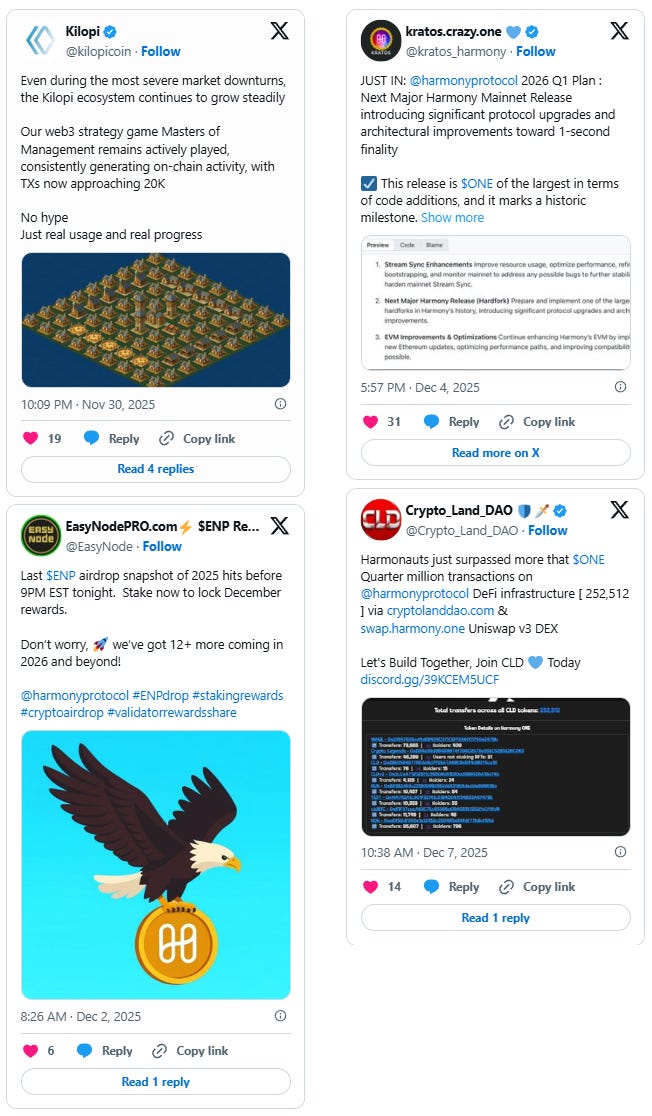
Ecosystem activity prioritized functional usage. Kilopi’s strategy game maintained consistent on-chain volume, and EasyNodePRO and Crypto_Land_DAO managed staking snapshots and DeFi processing. Kratos concluded the month by highlighting the Harmony Q1 roadmap and scheduled protocol upgrades.
Top 3 Team Progress:
Yuriy: Built a comprehensive hedging test suite with predictable swap scenarios and pre-calculated PnL, uncovering critical edge cases when market direction reverses.
Ulad: Deployed the 2025.1.2 release candidate to mainnet, identified gas discrepancies across versions, and safely rolled back affected nodes to preserve network stability.
Theo: Derived a corrected hedge-step formula that properly relates buffer distance to hedge position, fixing a core modeling error identified during team syncs.
Week of December 8th
Engineering shifted to real-time execution. Yuriy and Rikako updated median- and spike-based hedging, resolved impermanent loss edge cases, and validated performance against multi-month datasets. Aaron modified backtesting for IV crush and fee modeling. Simultaneously, the core team updated gas accounting and finalized EVM fixes for the 2025.1.2 release.
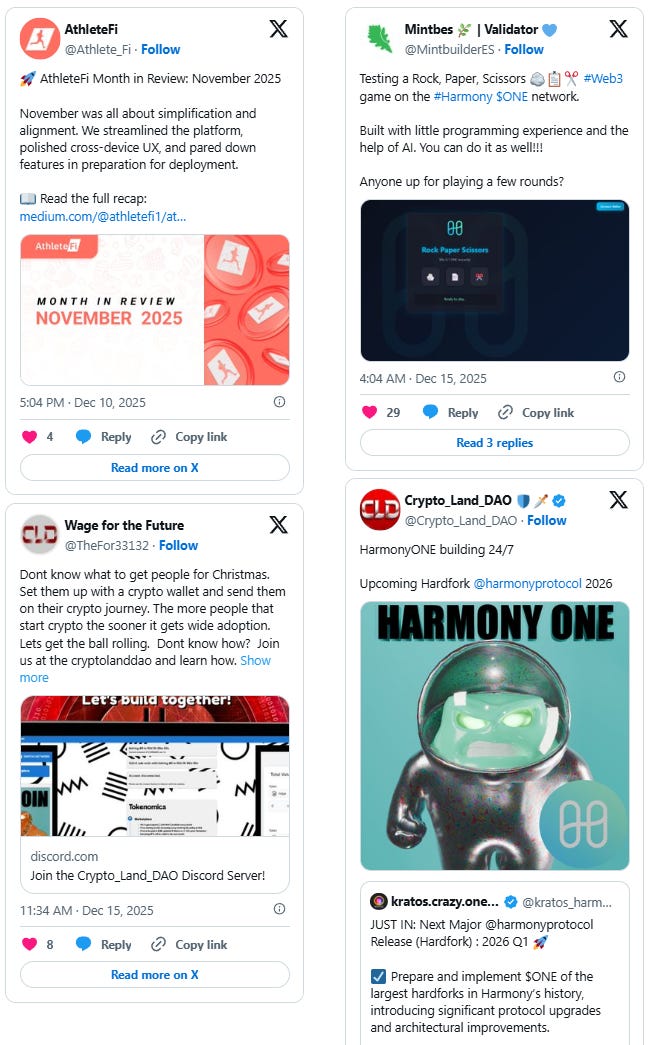
On-chain activity included AthleteFi’s deployment updates and Mintbes’ testing of creator-focused games. Crypto_Land_DAO provided wallet setup documentation for new users. Validators began technical preparations for the 2026 hardfork and subsequent protocol upgrades.
Top 3 Team Progress:
Yuriy: Adapted the hedging system for real-time operation using WebSocket swap streams and validated median strategies that filter random price spikes while preserving hedge performance.
Gheis: Merged critical EVM and sync fixes that prevent potential mainnet forks, align gas accounting with Ethereum upgrades, and significantly improve Stream Sync stability and bootstrap reliability.
Rikako: Corrected impermanent loss calculations at tick boundaries, implemented median and spike strategies, and produced multi-month hedge performance summaries for consistent strategy comparison.
Week of December 15th
Work shifted to live operations and release readiness. Aaron tested the rescue tool and calibrated call spread strategies against actual market behavior. Yuriy deployed the initial Hedge Manager service for real-time decision-making. Concurrently, Gheis and Ulad finalized EVM fixes and resolved CI issues for the 2025.1.2 release.
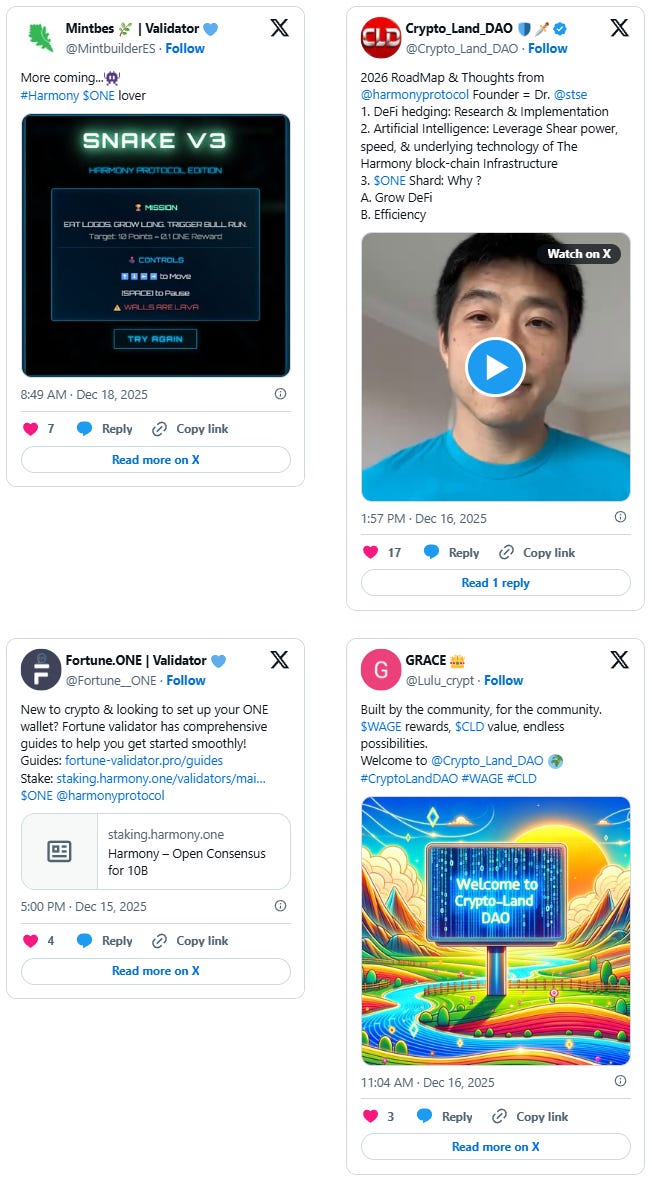
Ecosystem activity focused on deployment and documentation. Mintbes released new games, and Fortune.ONE updated validator guides. Community activity centered on DeFi scalability and protocol efficiency.
Top 3 Team Progress:
Yuriy: Delivered the first production-ready Hedge Manager service, enabling real-time hedge position management using live swap data, containerized deployment, and persistent performance tracking.
Aaron: Finalized and tested the rescue tool while refining call spread strategies and investigating discrepancies between simulated and actual trading fees.
Gheis: Fixed critical EVM tracer and CI issues ahead of the 2025.1.2 release, improving execution safety, test reliability, and overall mainnet readiness.
Week of December 22nd
The team concluded December by stress-testing real-time hedging. A 24-hour live test identified margin exhaustion during price trends, resulting in adjusted rebalancing ranges. Rika and Yuriy updated leverage handling to align with Hyperliquid execution. On the protocol side, Gheis resolved race conditions and Ulad integrated improved operational monitoring.
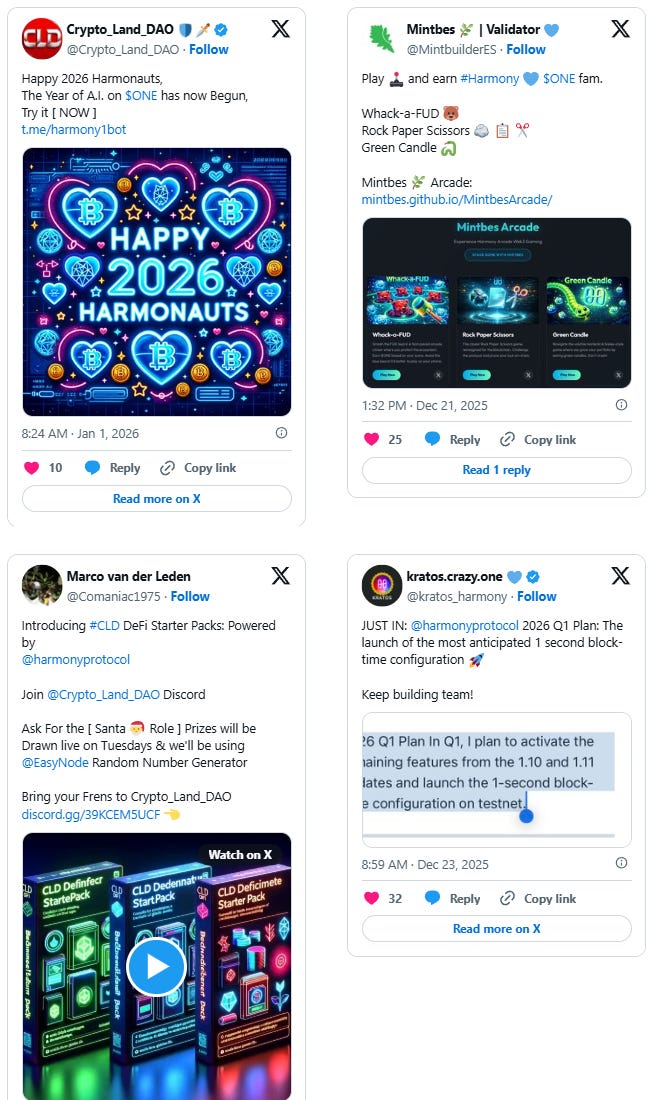
Ecosystem activity included Crypto_Land_DAO’s release of DeFi tools and starter packs. Mintbes added to its game catalog, while Kratos confirmed Q1 plans for protocol upgrades and 1-second block times.
Top 3 Team Progress:
Yuriy: Identified and resolved margin exhaustion issues in the live hedge manager by tightening execution ranges and improving logging to reconcile theoretical and actual hedge positions.
Gheis: Fixed critical race conditions and Devnet configuration mismatches, improving CI reliability and ensuring network settings behave consistently across environments.
Rikako: Added leverage handling, fallback margin errors, and position size fixes to the hedge execution branch, improving accuracy between modeled and live trading behavior.
Harmony concluded 2025 by transitioning its strategy systems from development to live operation. Engineering efforts in December focused on protocol upgrades and real-time hedging on impermanent loss with analytics. These updates finalize a year of refinements intended to support on-chain utility. Moving into 2026, the focus shifts to scaling these established systems and further standardizing DeFi infrastructure for builders and users.