

Throughout February, the team focused on strengthening the foundations of Harmony's automated trading and data infrastructure. The team deployed a central backtesting service, fixed modeling gaps between simulations and live copy trading, and consolidated multiple strategies into the unified liquidity-providing hedging strategy framework. On the protocol side, Stream Sync went through weeks of reliability fixes and was validated across all networks ahead of the v2025.1.2 release. Governance tooling was open-sourced at gov.harmony.one for community contribution.
Week of February 2nd
Aaron deployed the centralized backtesting server with pool state verification, daily snapshot syncing, and parallel testing across varying configurations. Rika reworked AERO rewards to use pool-share based calculations, implemented accurate dynamic swap fee modeling from on-chain data, and replaced artificial delay parameters with block-based execution timing. Yuriy tested a new copy trading mode with fixed-limit token rebalancing and worked with Rika to align backtesting logic with real bot behavior. On the protocol side, Gheis fixed peer selection and goroutine closure bugs in staged Stream Sync, while Konstantin and Ulad began testing the release candidate across devnet, testnet, and mainnet.
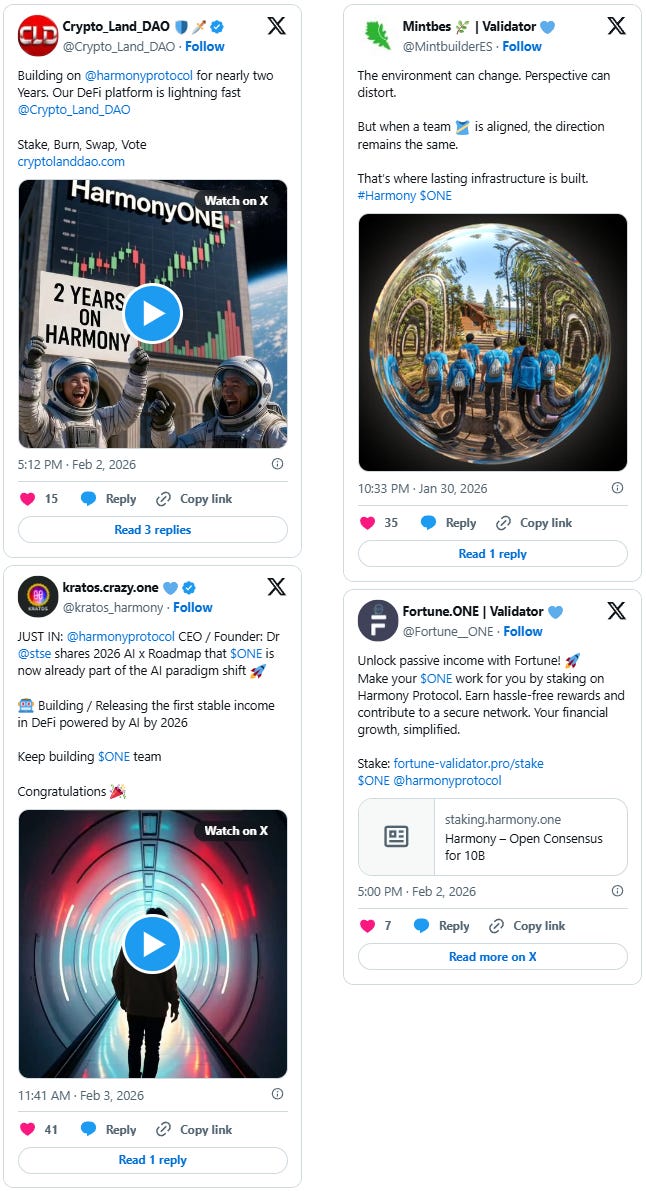
Crypto_Land_DAO celebrated nearly two years building on Harmony, highlighting their DeFi platform. Mintbes and kratos.crazy.one posted about team alignment, the 2026 roadmap, and building lasting infrastructure. Fortune.ONE promoted staking through their validator and encouraged new holders to participate in the network.
Top 3 Team Progress
Aaron: Deployed and validated the centralized backtesting server with automated pool state scanning, synchronized snapshots, and parallel configuration testing to ensure historical data correctness.
Rika: Corrected swap fee, reward, and execution modeling in liquidity provider backtests, aligned simulations with real bot behavior, and extended analysis to compare copy bot, target wallet, and backtest outputs.
Gheis: Fixed Staged Stream Sync concurrency and peer selection bugs, improved logging accuracy, and continued reliability work to make sync safer under high parallel load.
Week of February 9th
Yuriy hardened the copy trading bot with unified nonce management, serialized transaction submission, and an aggressive Ethereum Improvement Proposal 1559 fee policy to reduce missed positions and cut Alchemy remote procedure call costs. Rika fixed AERO rewards overestimation, a capital under-utilization bug for large wallets, and an inverted decimal scaling issue in swaps, while reducing backtest runtime from 17+ hours to 80 minutes through parallel processing and caching optimizations. Gheis resolved critical peer-to-peer Stream Sync issues including stream leaks from improperly closed rejected streams, a deadlock in the progress tracker, and boot node startup failures where the profiling server was blocking boot node initialization. Ulad restructured Domain Name System traffic routing for full-database remote procedure call nodes to rebalance load across regions after the Lithuania server reached 90–100% processor utilization, and built a unified Grafana dashboard to visualize network flow.
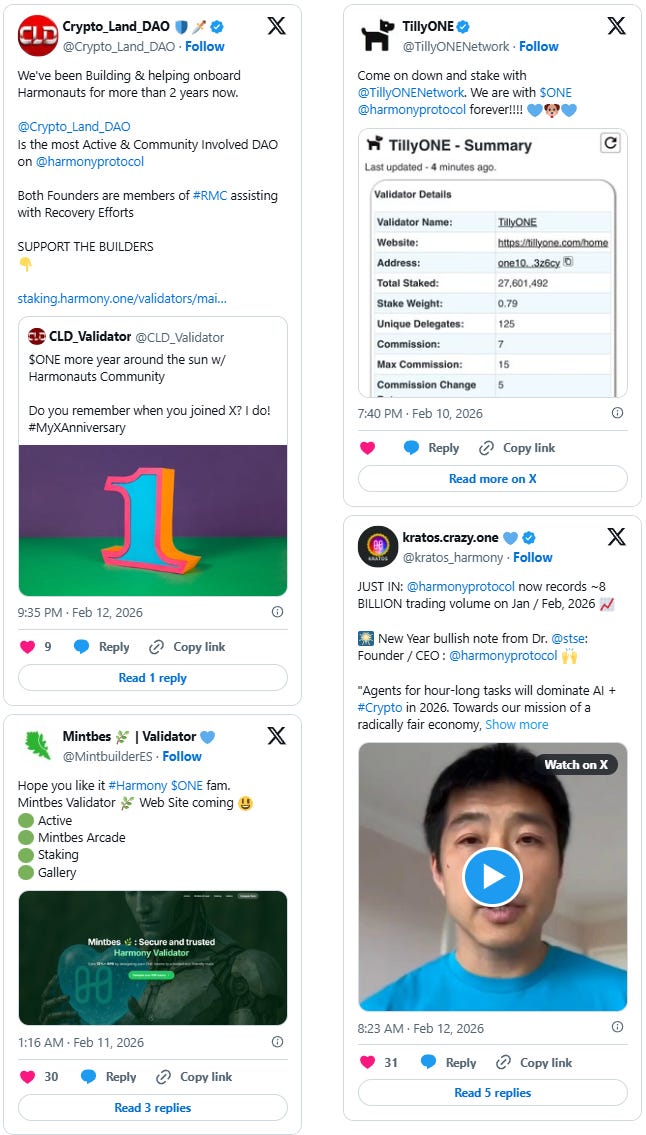
TillyONE promoted staking with their validator, showing 27.6M total staked across 125 unique delegates. Mintbes teased an upcoming website featuring their arcade, staking, and gallery services. Crypto_Land_Dao and kratos.crazy.one celebrated long-time contributors and collaborated on what the new year will bring for the ecosystem.
Top 3 Team Progress
Yuriy: Hardened the copy trading bot with unified nonce management, serialized transaction submission, and optimized remote procedure call usage, reducing missed positions and improving production stability.
Rika: Fixed major reward, swap, and capital utilization bugs in large-wallet backtests and reduced runtime from multi-day to hours, enabling accurate high-capital simulations.
Gheis: Resolved critical peer-to-peer Stream Sync leaks, deadlocks, and boot node startup issues, improving network stability under high peer load.
Week of February 16th
Aaron expanded the backtesting platform with database indexing, automated daily data ingestion with Telegram reports, a performance dashboard, and support for multiple strategies including random liquidity provider, random perpetual, spread hedge, and volatility harvesting within a unified liquidity-providing hedging strategy. Yuriy and Rika traced copy trading discrepancies to same-block mint and burn handling and corrected it with execution delay modeling. Yuriy also published a fully open-source version of gov.harmony.one with user interface, contracts, and indexer deployed for community contribution. Rika began planning the migration of the copy bot, backtest, and returns scripts into the liquidity-providing hedging strategy repo to consolidate the codebase. Gheis completed and deployed per-stream block caching on devnet, eliminating repeated round-trips and cutting sync network load, while Ulad coordinated release planning and deployed Stream Sync improvements across devnet and testnet.
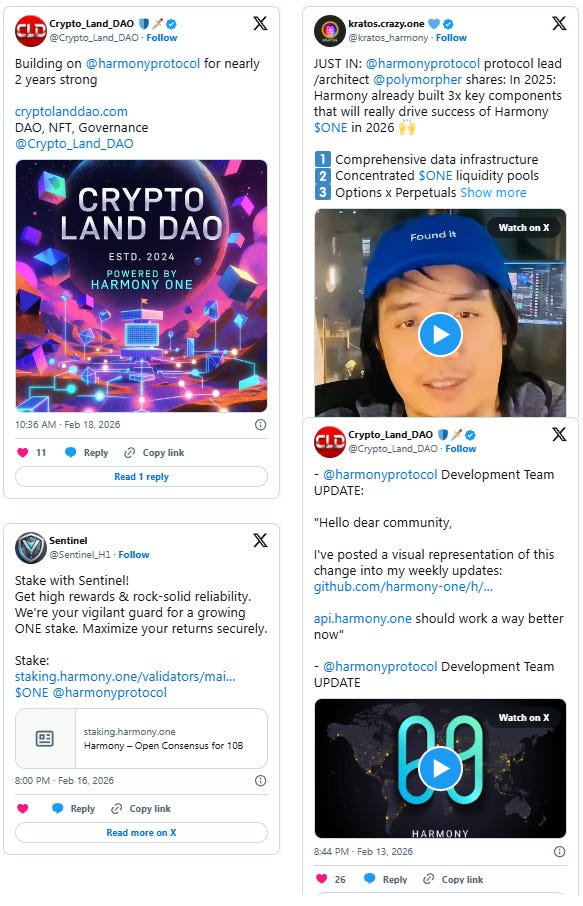
Ecosystem leaders supported outreach by spotlighting updates from the team regarding weekly protocol updates and current initiatives. Different validators continue to be featured at harmony.one. Sentinel promoted staking rewards and reliability through their validator. Crypto_Land_DAO amplified improvements to api.harmony.one alongside a summary posted to GitHub.
Top 3 Team Progress
Aaron: Expanded the backtesting platform with database indexing, automated data ingestion, performance dashboards, and multi-strategy support integrated into the liquidity-providing hedging strategy.
Yuriy: Open-sourced and deployed gov.harmony.one with user interface, contracts, and indexer. Resolved copy trading vs backtest discrepancies through same-block execution delay modeling.
Gheis: Implemented per-stream block caching and deployed to devnet, significantly reducing sync network load and improving reliability.
Week of February 23rd
Gheis finalized Stream Sync reliability work with fixes for Domain Name System self-connection attempts, race conditions in stream lifecycle handling, and a restructured synced-stream classification that avoids penalizing healthy streams during transient errors. Ulad validated and deployed these improvements across devnet, testnet, and mainnet, where nodes now establish 3 streams within minutes of a rolling upgrade versus roughly 10 minutes before. Aaron added spread costs and taker fees to backtesting, improved profit and loss attribution with separate impermanent loss, realized/unrealized, and principal/fees breakdowns, and uploaded automated backtest log to Google Storage so interrupted runs are preserved. Yuriy began migrating the hedger manager strategy into the backtesting engine and improved the gov indexer with block persistence on shutdown and missing-block recovery. Rika started setting up the liquidity-providing hedging strategy locally and debugging copy-trade detection issues.
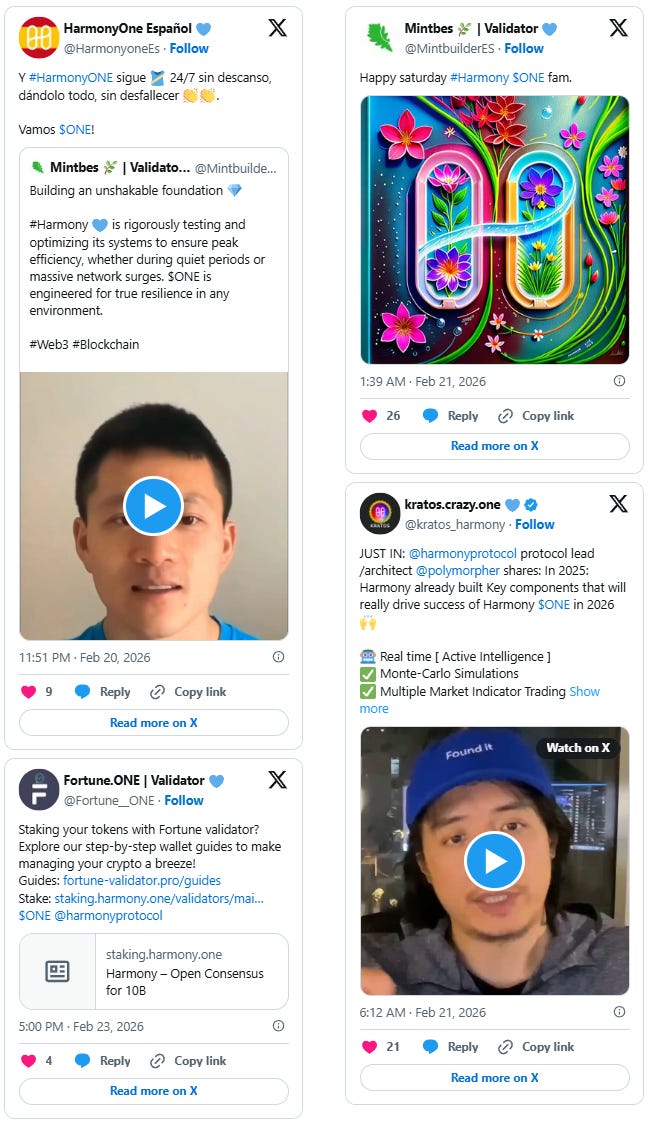
HarmonyOne Español amplified Mintbes' post about Harmony testing and optimizing systems. Ecosystem leaders outlined core trading and analytics components supporting Harmony’s DeFi direction. Fortune.ONE shared guidance and onboarding support for token holders and new Harmonauts.
Top 3 Team Progress
Gheis: Finalized Stream Sync reliability upgrades including race condition fixes, Domain Name System peer handling, and resilient synced-stream classification ahead of the v2025.1.2 release.
Aaron: Added execution costs, improved profit and loss attribution, automated log uploads, and client-side performance profiling to increase backtesting realism and observability.
Ulad: Validated and deployed final Stream Sync release candidate across networks, improving peer stream establishment speed and preparing the v2025.1.2 announcement.
Conclusion
By the end of February, backtesting reflects real trading conditions more accurately with execution costs, proper profit and loss attribution, and multi-strategy support. Copy trading is more stable in production after nonce, fee, and network call optimizations. The Stream Sync improvements were validated on devnet, testnet, and mainnet and are included in release v2025.1.2. With these foundations in place, the network and ecosystem continue progressing toward more scalable strategy deployment and participation. 💙